How to paint a gun (with photos)
80 Percent Arms | Aug 26th 2021
Cerakote paint, hydro-dipping, custom work… it’s all very cool and all but it can be expensive. Rattle canning (spray paint) is so much more affordable and it’s not permanent! For six bucks, you could buy a single can and that would be enough to paint an entire rifle just the way you want it. The coating may not be as durable as cerakote but hey it’s fun and is a cheap way to make your gun look different! We’re not saying that black rifles don’t matter, but we just like to change it up every now and then.
Steps to Spray Paint Your AR-15 (Without a spray gun)
These are the six steps for how to paint a gun. It’s easy! Just takes a little bit of time and patience. Once you get more confident with your workflow you can employ the same techniques with any firearm or component.
1. Choose Colors To Paint Your Gun
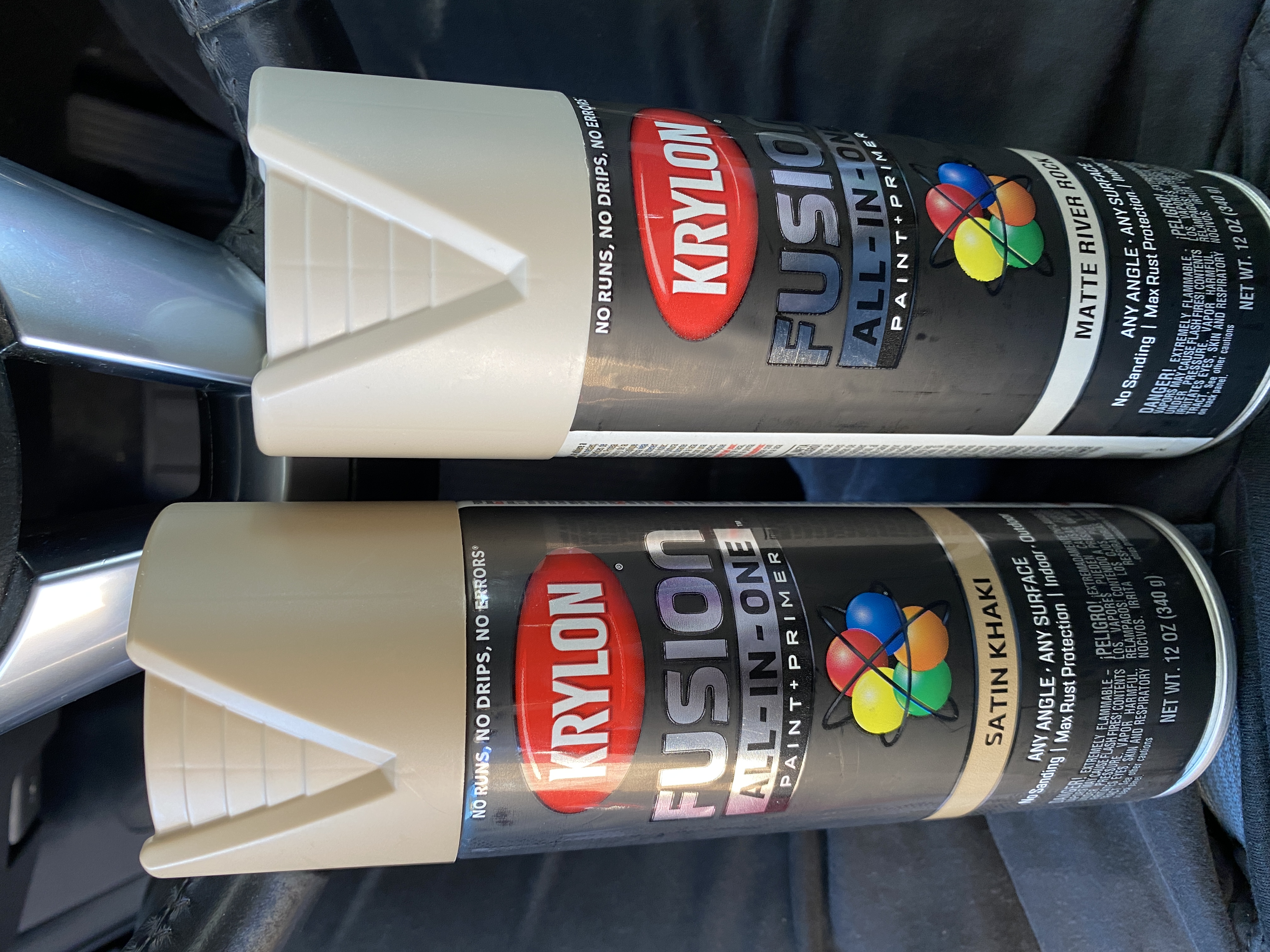
For this 11.5 build, we’re going with a combination of two different Krylon FDE like colors which were bought at Lowe's. Eventually, with enough different tan colored accessories and parts it might look like it was built by Q. At least that’s the hope.
2. Clean/Prep Surface
The first thing you’ll want to do is to clean your gun. We need to have every nook and cranny as clean as possible to prepare the surface to have a new coat of paint evenly distributed over it. To do this you should take some cleaning patches or a Scotch Brite sponge and wipe down every surface you expect to paint with rubbing alcohol. Brake cleaner works great too as it will mostly just evaporate on its own, but know that it’s a pretty harsh chemical.
Depending on your setup, you may have to take apart the rifle if necessary to remove parts for getting a better angle or access to some areas of the gun when painting such as the hand guard, pistol grip, lower receiver from the upper receiver, safety selector or butt stock.
3. Masking Tape Is Your Friend
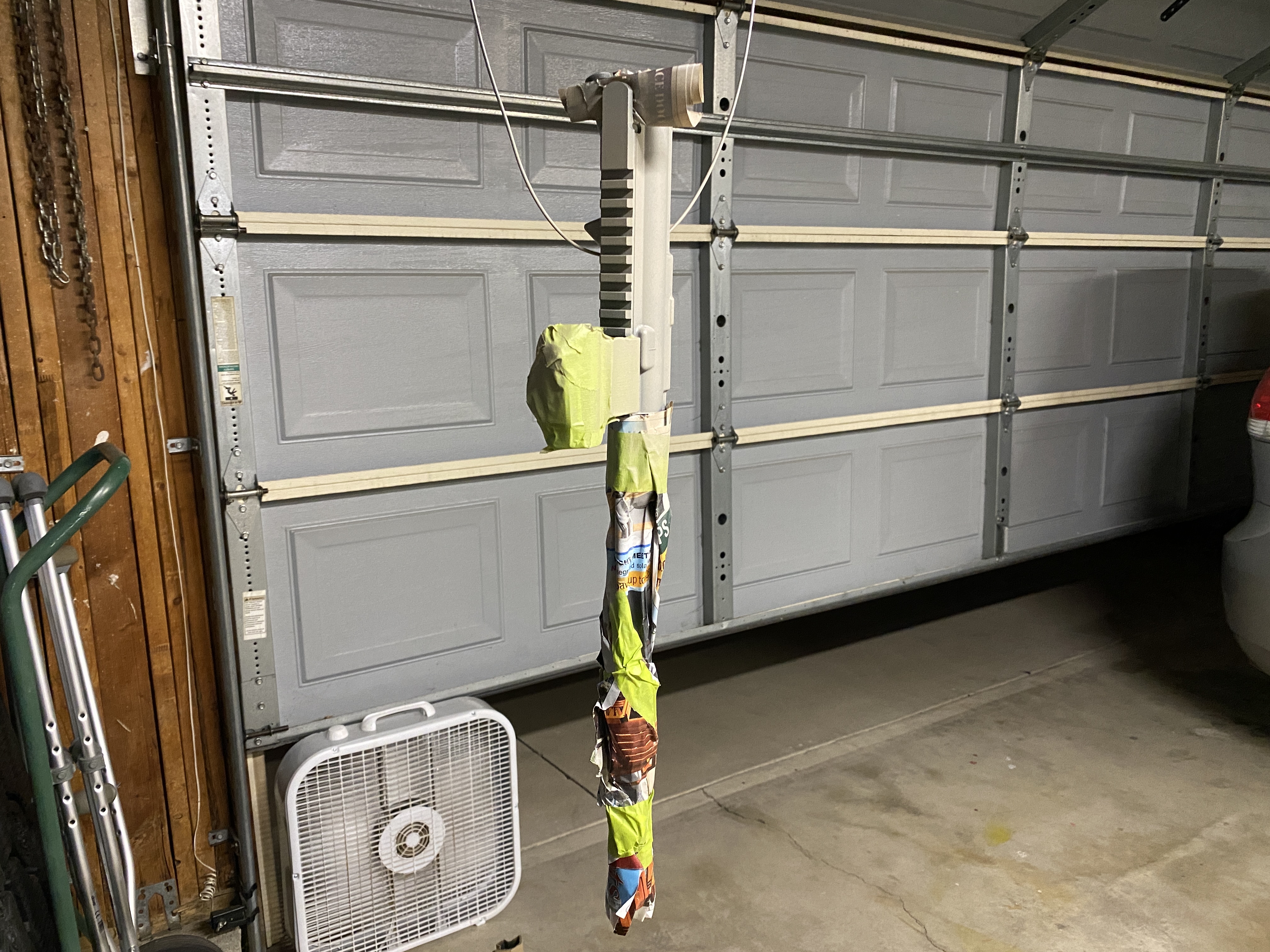
Once our rifle is clean and devoid of any carbon or debris lying around we’ll inevitably have to tape off some areas that we don’t want to get painted. Say you have a red dot on the top picatinny rail, but it’s already zeroed and sighted in so you really don’t want to move it. Not a problem! Just tape that bad boy off and cover as much of it as possible, double layer it if good measure.
You’ll specifically want to tape off where the pistol grip attaches to the lower receiver as well so that you don’t have fitment issues later on. You may want to roll up a paper towel and put pieces through the safety selector hole as well so you don’t get unwanted paint into the trigger pocket inside the lower receiver. For the mag well, consider using a sacrificial magazine by keeping one locked in so no paint gets in the mag well while painting. But if you have a flared mag well you may have to use a paper towel in the end anyways to stuff the hole so you can get an even spread of paint on the mag well’s flared areas.
If you don’t want to take apart as many parts you can also get away with wrapping parts of your AR15 rifle with pages from a magazine such as the barrel or muzzle device.
4. Set up painting area
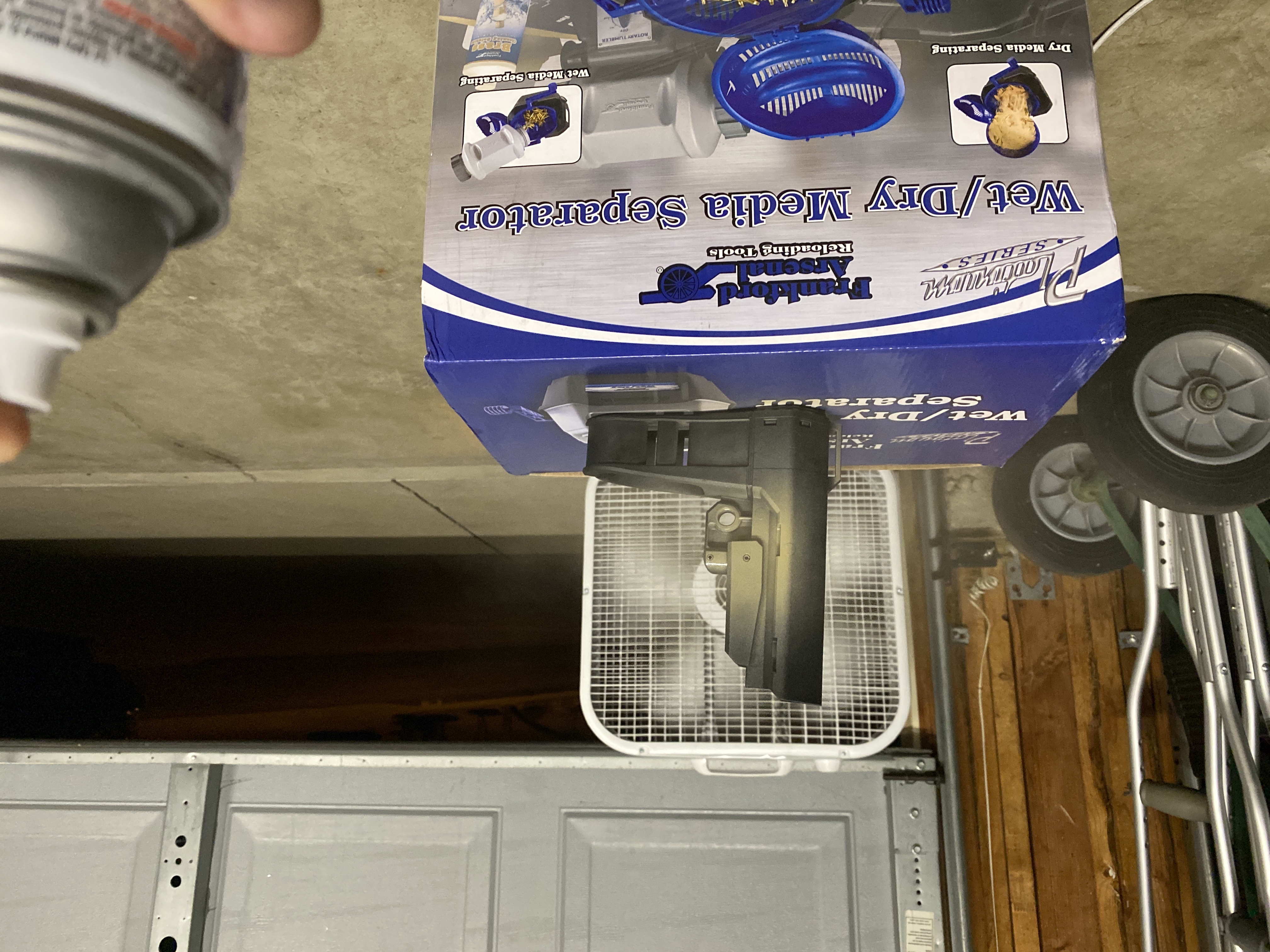
The workspace painting your gun is also very important. To stay out of your neighbors’ watchful eyes, and assuming you have access to one, we prefer to do most of our painting in the garage at home. It’s a convenient space where you can still be pretty private and won’t have to worry about moisture or outdoor weather as much if you were to leave the rifle or its parts in there to dry over a longer period of time.
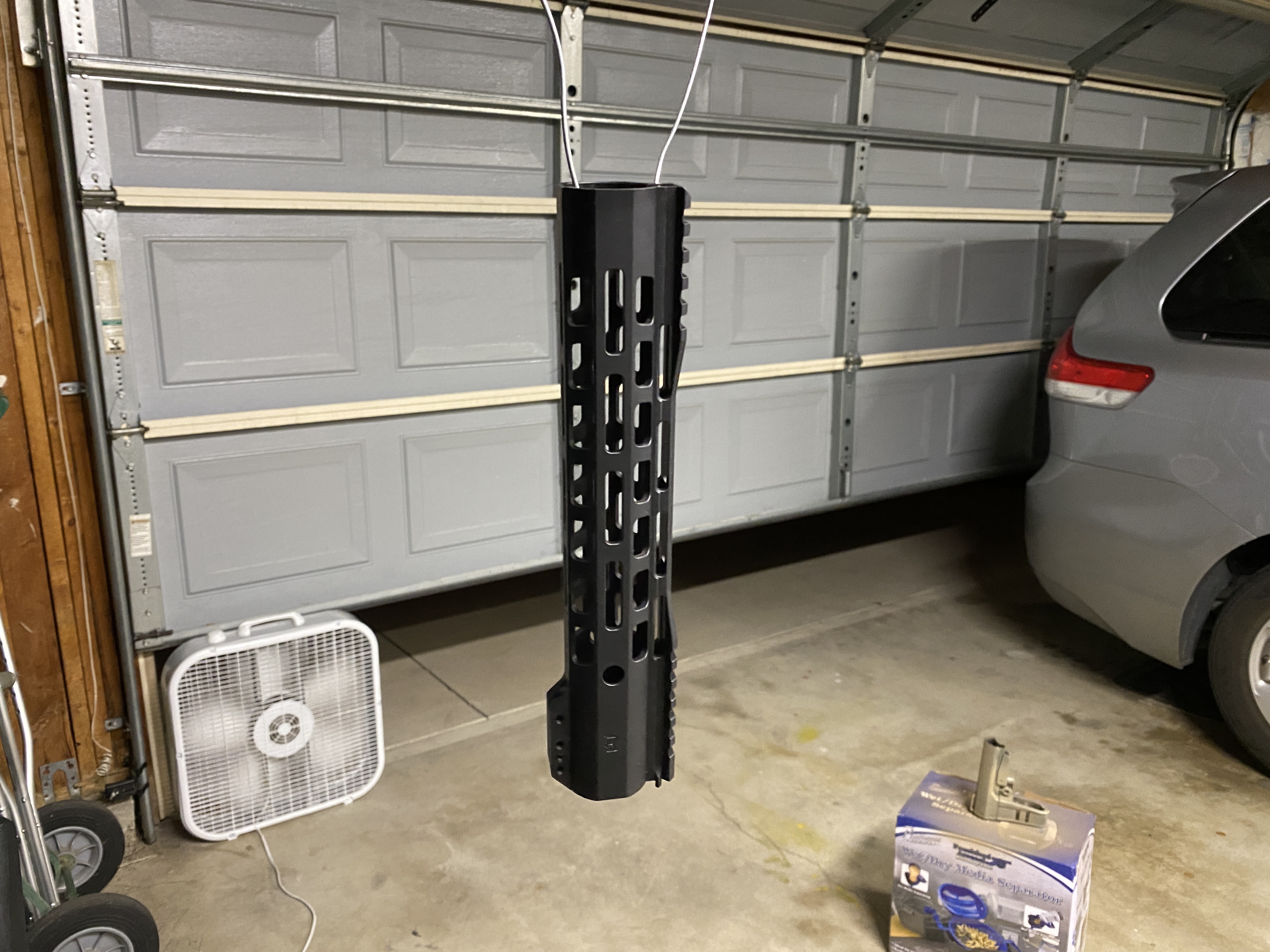
Here’s how I do it: I close the garage door so it sandwiches my fan at the bottom, preventing it from closing. I keep the fan on at a high speed pointing towards my driveway so that it can suck all the fumes out of the garage and provide better ventilation while I”m in there. You know those rails that your garage door rolls on open and close? Along with some wire, that’s what we’ll use to hang our AR-15 up and other parts for painting. If your garage door isn’t too tall you might be able to get away with just using a clothing wire hanger as well.
As the part that you're about to paint is suspending in air you twist and rotate it to conveniently spray down the part(s) from all sides and angles. Some parts might be better to paint while sitting on a box instead of being hung up by wire, such as butt stock. In this case, you can place the stock on a box behind the fan so as you paint the excess is sucked out of the garage. It’s not fancy, but you’ll still be able to rotate the box as necessary.
5. Spray Paint Sparingly
Now that you’re full-on in painting mode, make sure you actually go easy on the paint. Spray paint sparingly and make sure that you don’t spray so much to the point that it looks wet. That will cause the paint to drip or run and it won’t look so good.
Instead, spray paint bit by bit with quick and thin passes. It is 100% okay if it’s not even, you can address it in your next pass. Apply a new coat every 20 minutes or so until the rifle or individual part has been completely and evenly painted. Check with a flashlight to make sure you didn’t miss any obvious spots.
For the drying process you can choose to leave it for a couple of days to let it dry naturally or you can also toss some parts into a toaster or conventional oven and heat it to 225 degrees Fahrenheit to speed up the process (leave it in there for anywhere between 2-6 hours). Either way, take your time for best results. Don’t be in a hurry to put everything back together and touch every part of your newly painted build too soon.
Don’t worry about overspray. That’s what acetone is for. Acetone can easily remove any type of spray paint. Say you accidentally painted part of that red dot sight you were worried about earlier, well, dip another patch in acetone and wipe away. No problem. However, acetone is so effective at removing spray paint that you’ll want to be extra careful you don’t accidentally remove paint in areas you didn’t intend to.
6. Reinstall parts and Put Rifle Back Together
Assuming it has been multiple hours now of parts being in the oven or a couple days that your rifle has been drying in the garage, the paint has set and you are ready. (Make sure all the parts are cool or dry enough to touch for you to reinstall all the parts.) Once all the components have been put back together, bask in your handy-ness and creativity cuz you’ve got a swell looking gun now. To untrained eyes, they’ll just think it was a custom cerakote job!
How To Paint A Gun Camo
So you want to know how to paint your gun camo? There’s quite a few fun ways. First, you’ll need at least two or three different colors of spray paint:
How to Paint a Gun Camo - Using Fish Net

Once you’ve chosen your colors and completed prepping it with the same aforementioned steps you can cover the desired parts or your entire rifle with a fish net and then paint over it. By repeating these steps with a couple different colors it gives off a real rugged looking pattern like your gun just came back from fighting in the Middle East… or it might look like you just borrowed your old lady’s pantyhose. Some also might opt for various patterns layered on top of each other as well such as using chicken wire, a part of a chain linked fence, etc.
How to Paint a Gun Camo - Using Foliage

Probably one of the more popular methods, you can use various pieces of foliage like tree branches, leaves or pine needles to make some pretty cool patterns. This is also not too difficult! (Use all the same preparation steps that we’ve noted above) You can do this however you want but the coolest results we’ve seen always involve three colors being used. One is used as the base so first you paint that color over the gun. Next, put some foliage onto the gun and paint over that with your next color.
Then, add more foliage and paint over the gun again with your final color. If you’re painting a gun or parts face down on the ground you don’t need to wait for the paint to dry between each step but you’ll have to wait for all of it to dry before painting the other side. If you’re painting a gun or parts that are suspended in air by wire you’ll have to hold up the foliage against the gun while painting over it.
How to Paint a Gun Camo - Using Masking Tape
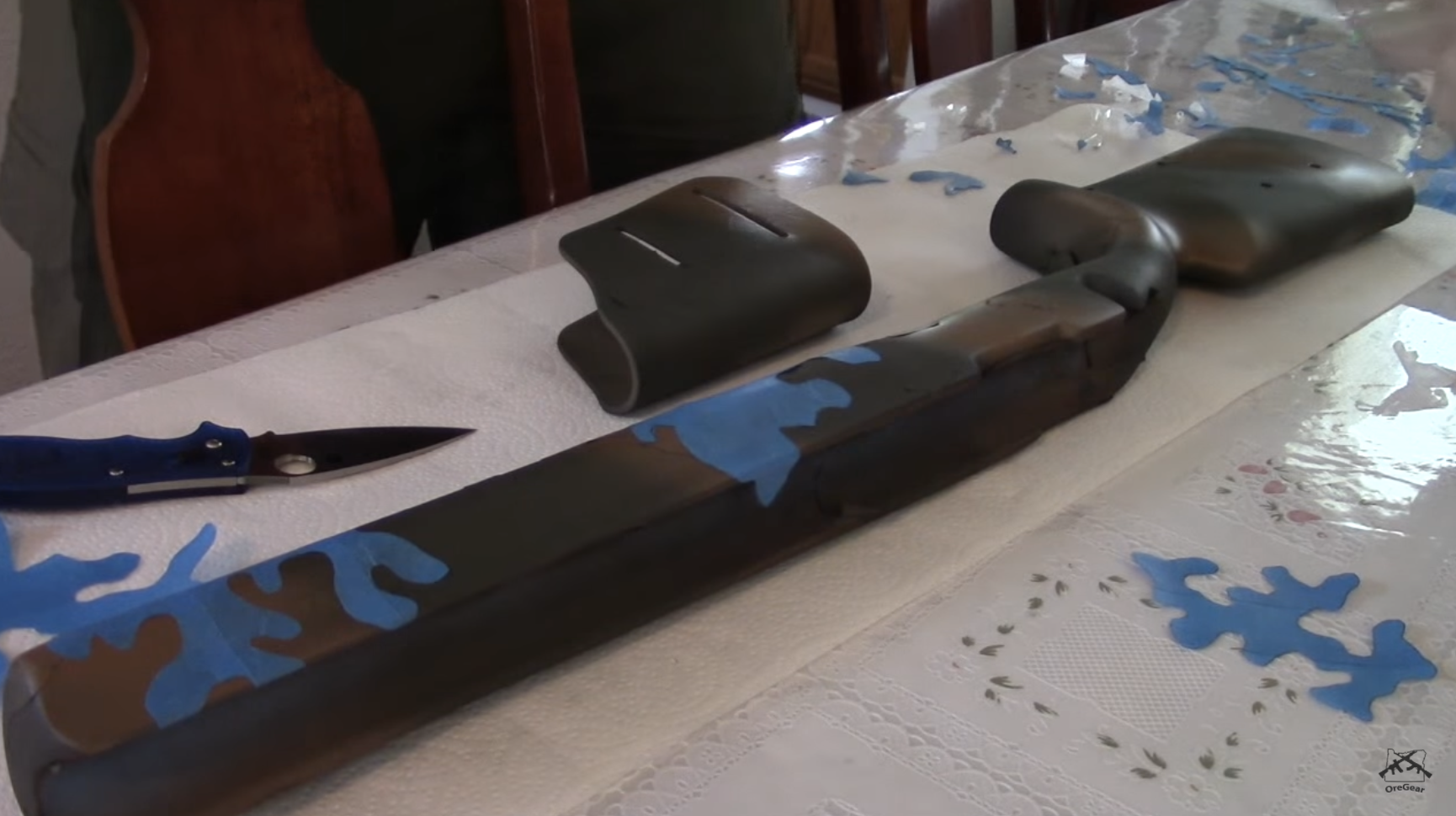
This method renders the best results in quality and looks but is definitely the most difficult and takes a good amount of work. Whether you’re going for a more modern pattern such as Multicam or a video game style that might appear as a skin in Call of Duty, you’ll achieve those pattern looks by using masking or painter’s tape. (Use all the same preparation steps that we’ve noted above) With your chosen tape, you’ll have to create stencils.
These shapes should conform to the style of camouflage pattern that you want as digital, woodland, A-TACS and Multicam are all obviously different. To get a good stencil shape you could print out the shape of the camo pattern onto regular printer paper and use that to trace over tape as you cut out your tape stencils. Notice in the photo above that the shape of the tape is a Multicam pattern. What you’ll want to do is put a few pieces of this tape on and paint over it with your first color. As you add more pieces of masking tape to the gun you should move on to your other spray paint colors.
Eventually, you shouldn’t see any of the tape and just the layer of paint from your last pass. Once the paint has dried and set, carefully remove all the tape to reveal the fruits of your labor. If you want to cheat, there are some who sell these stencil shapes online which can save you a good amount of time and might look more accurate too. Otherwise, you’ll have to painstakingly cut out those shapes yourself.
How to choose paint

It’s easy to feel lost when looking at shelves and shelves of spray paint cans in an aisle at Home Depot. Perhaps even more so when browsing online. Generally, speaking you can’t go wrong with painting a gun with Krylon or anything from Rust-Oleum. Dupli-Color could work too as it’s designed for car parts which need to withstand high heat and be resistant to oil and fluids.
Most spray paints these days come with primer in the can too so you don’t have as many steps to do as before. If you’re unhappy with the results, again, just acetone it and start over or try another kind of paint or color.
But if you’re in an experimental mood there are some fun options for you to explore. Try checking out DuraCoat or Brownells DuraCoat-equivalent product called Aluma-Hyde II. These paints are designed to set just from air drying but are essentially no different from a regular old can of spray paint.
The pros use paint that is set by being cured and dried by heat. If this is of any interest to you, check out what DuraCoat has to offer with their DuraBake products. You’ll definitely need a full sized oven for painting larger rifle parts so keep that in mind. If you want to get really wild there’s a whole new world for you to discover with powder coatings.
Start your next build and custom spray paint job with 80% Arms!
The cool thing about this hobby is whether you want to know how to paint a gun barrel or how to paint camo on a nerf gun, the knowledge and skill set is one and the same. Pretty soon you might just find yourself on a painting bender finding all sorts of stuff to make into a different color. We carry bead blasted 80% lower receivers that are immediately ready for you to paint! And once you’re finished painting your AR15, at the end of the day, you’ll get to say “there are many rifles like this, but this one is mine.”

