
AR-15 Ban Lawsuits: The 2026 State-by-State Map of the Fight
80 Percent Arms | Nov 20th 2026
Nationwide AR cases
Twelve days before the Supreme Court hears its first AR-15 case, the country's rifle bans sit in very different places. One federal appeals court has struck a ban down, seven appellate rulings have upheld bans, and a Virginia judge blocked that state's ban before it began. If you build from an 80 lower, or buy, sell, or carry an AR-platform rifle, the answer in your state may change within a year. This map shows where each state stands, who is suing, and what each court order does and does not change.
By the 80% Arms editorial team Status as of November 20, 2026
Dated status: as of November 20, 2026. This edition adds the November developments. The Supreme Court let the Solicitor General argue, the challengers filed their final brief, Virginia's injunction widened, and Colorado's permit law drew two rulings. Case postures come from court dockets, state and federal releases, and dated news reports.
The short answer
Most AR bans still stand while the Supreme Court decides.
The Court hears the case December 2. It reviews Connecticut's ban and Cook County's, and a ruling is expected by June 2027.
The map is split. New Jersey's ban was struck down, but it stays enforced during the state's appeal. State judges have blocked Virginia's new ban. The other nine state bans, plus the District's, are in force.
Next step. Find your state on the map below, and check its row again after December 2 before you buy, sell, or build.
Where every state stands
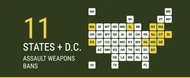
Eleven states and Washington, D.C., have assault weapons bans on the books, by The Trace's count. They are California, Connecticut, Delaware, Illinois, Maryland, Massachusetts, New Jersey, New York, Rhode Island, Virginia, and Washington. Hawaii bans assault pistols only. Rhode Island and Washington ban sales and manufacturing but not possession, and Virginia's law targets buying, selling, and making covered guns.
- Ban blocked by a court
- Ban struck down, still enforced during appeal
- Ban in force, challenge pending
- Ban in force, no live challenge in our sources
- No ban; magazine, permit, or waiting-period rules challenged
- No assault weapons ban in the checked records
- Case or petition waiting at the Supreme Court
- Local ban with its own federal case
Magazine limits are a second layer. Besides New Jersey, at least 13 states and the District restrict large-capacity magazines, The Trace reports. Those limits ride on separate cases, and no magazine case is on the Supreme Court's December calendar.
Read the map as litigation posture, not permission. A ruling binds its parties until an appellate mandate issues, many bans grandfather guns owned before the cutoff, and a struck law can stay enforced while an appeal runs. The color tells you where a state's fight stands. The ring tells you whether a case or petition from that state is waiting at the Supreme Court.
Find your state
Search the board for your state, a court, or a posture. Each row is condensed from the dated sources linked in this post.
| Jurisdiction and law | Posture now | Next date |
|---|---|---|
| New Jersey Sale and possession ban, magazine limit |
Struck down en banc July 17; stayed August 4 | Petition likely held for the December cases |
| Connecticut Ban since 1993, tightened after 2012 |
Upheld by the Second Circuit; now at the Supreme Court | Argument December 2 |
| Cook County, Illinois Local ban since 1993 |
At the Supreme Court; the county argues the case is moot | Argument December 2, unless dismissed |
| Illinois State ban signed in 2023 |
Upheld by a Seventh Circuit panel July 9 | Challengers' petition due December 4 |
| Massachusetts Ban on selling assault-style firearms |
Upheld by the First Circuit in 2025 and 2026 | State's response to a store owner's petition due December 7 |
| Maryland Ban, handgun roster, convertible-pistol law |
Ban upheld en banc in 2024; review denied in 2025 | Convertible-pistol suit in district court |
| Virginia Purchase, sale, and manufacture ban; magazine limit |
Blocked by state judges; widened to state agencies November 2 | Lancaster County order runs through December 31 |
| Rhode Island Sale and manufacturing ban since July 1, 2026 |
No reported challenge to the rifle law | None set |
| Delaware Ban with a 17-round magazine limit |
Review denied in 2025; district cases pending | Bound by the New Jersey en banc ruling |
| New York Ban, plus a 2026 convertible-pistol law |
Pistol law challenged in the Western District | Dealer penalties begin May 31, 2027 |
| California Rifle ban, magazine ban, roster, convertible pistols |
Magazine petition held; DOJ lost a restraining-order bid | Ninth Circuit after the ruling |
| Hawaii Assault pistol ban; rifle bill failed in 2025 |
No live challenge in our sources | None set |
| Colorado Magazine limit; 2025 permit-to-purchase law |
DOJ magazine suit pending; permit law survived a facial challenge November 18 | Jury trial next spring |
| Denver City-county ordinance from 1989 |
Federal suit filed after the city refused to stop enforcing | District court |
| Washington, D.C. Registration ban and 10-round magazine limit |
DOJ rifle suit pending; magazine limit being reheard en banc | En banc decision in Benson |
| Oregon Magazine limit and permits, by ballot measure |
Trial-court block reversed on appeal in 2025 | Start date pushed to January 1, 2028 |
| Washington Sale ban since 2023; magazine sales ban |
Magazine petition held at the Supreme Court | Gator's Custom Guns petition |
| Minnesota No ban; permit-to-purchase and waiting period |
DOJ suit filed September 24 | District court |
| U.S. Virgin Islands Territorial ban and permit rules |
DOJ suit against the police department | District court |
The board lists statewide laws plus the two local bans that have their own federal cases, Cook County and Denver. The board shows posture, not statute text, so open your state's statute for the exact list of covered features. Stays, mandates, and effective dates do not move together, so two rows can both be right about one state on the same day.
The Supreme Court case, twelve days out
On June 30, 2026, the Supreme Court agreed to decide whether Americans have a right to possess "AR-15 platform and similar semiautomatic rifles" under the Constitution. It joined two cases for one hour of argument on December 2: Viramontes v. Cook County, over Cook County's ordinance, and Grant v. Higgins, over Connecticut's statute.
Three things moved in November. On November 9, the Court granted the Solicitor General's motion to take part in the argument, so the Justice Department will argue against the bans in person. On November 20, the challengers filed their final brief. It argues that the Court needs no new rule: Heller already protects arms in common use, and the AR-15 is the most popular rifle in the country.
The third development is a fight over whether the Cook County half survives. On October 29, lead petitioner Cutberto Viramontes asked to leave the case without saying why. Cook County then asked the Court to dismiss its case as moot. The county noted that the remaining individual petitioner, Christopher Khaya, wants an IMI Galil rather than an AR-15, as CNN reported. The county wrote: "There are no record facts concerning whether the IMI Galil weapon operates similarly to an AR-15."
The challengers answered on November 11, and the county replied two days later. The docket shows no ruling on the request as of November 20. Either way, the Connecticut case carries the same question, so the Court can decide it even if it drops Cook County.
A line of cases waits behind the December argument. New Jersey's own petition, case 26-452, asks the Court to reverse the Third Circuit. California's magazine case, Duncan v. Bonta, has been held since the Court's last June conference. Washington's magazine case, Gator's Custom Guns, and a second Connecticut petition, NAGR v. Lamont, are held the same way.
Two more filings are on the clock. The Court asked Massachusetts to answer a gun store owner's petition, Recchia v. Campbell, by December 7. Justice Amy Coney Barrett has twice extended the Illinois challengers' deadline, now December 4. The Court usually holds related petitions until the lead case is decided, then sends them back for another look.
Where the AR cases sit at the Supreme Court, as of November 20, 2026
Argued December 2
Viramontes v. Cook County
Cook County's ordinance. The county asks the Court to dismiss it as moot.
Grant v. Higgins
Connecticut's statute. It carries the same question either way.
Waiting at the Court
Davenport v. New Jersey Rifle & Pistol Clubs
New Jersey asks the Court to reverse the Third Circuit.
Duncan v. Bonta
California's magazine limit, held since June.
Gator's Custom Guns v. Washington
Washington's magazine sales ban, held since June.
NAGR v. Lamont
A second Connecticut petition, held since June.
Recchia v. Campbell
Massachusetts response due December 7.
Barnett v. Raoul
Illinois challengers' petition due December 4.
Waiting below
Virginia
State and federal cases paused until the Court rules.
New Jersey
The en banc ruling is stayed during the appeal.
Delaware
The district judge is bound by the New Jersey ruling.
Dockets checked on the Supreme Court website. A held petition usually waits for the lead decision, then returns to the lower court for another look.
The Justices have been signaling this case for two years. When the Court turned away the Illinois petitions in July 2024, Justice Clarence Thomas noted that it had never defined which weapons count as protected arms. He hoped the Court would take up the issues "after the cases reach final judgment."
In June 2025, when the Court passed on Maryland's ban, Justice Brett Kavanaugh wrote that decisions from other appeals courts "should assist this Court's ultimate decision making" on the AR-15. The Court granted review a year later, on June 30, 2026, and three more appellate rulings followed within weeks.
"We have never squarely addressed what types of weapons are 'Arms' protected by the Second Amendment"
Justice Clarence Thomas, July 2024
How the appeals courts have ruled
Since 2023, federal appeals courts have issued eight rulings on rifle bans in our sourced records. Seven upheld a ban and one struck a ban down. Four circuits upheld: the First, Second, Fourth, and Seventh. Only the Third Circuit, sitting en banc in the New Jersey case, went the other way.
The doctrine explains the split. In 2008, Heller held that weapons in common use for lawful purposes are protected. In 2022, Bruen told courts that a gun law survives only if it fits the nation's historical tradition of firearm regulation. Bruen also ended the balancing test many courts had used, so a law's safety purpose no longer decides the constitutional question.
The courts that upheld bans took two routes. The Seventh Circuit first treated the covered rifles as military-grade weapons outside the right, in Bevis v. City of Naperville in 2023 and in the Cook County case in 2025. In July 2026, a Seventh Circuit panel assumed AR-15s are protected and upheld Illinois's ban anyway. It wrote that "legislatures have long imposed restrictions on particularly dangerous weapons" and called the ban another chapter in that story.
The Third Circuit read the same precedents the other way. "Together, Heller and Bruen teach that bans or broad prohibitions on possessing or carrying of a class of weapons in common use for lawful purposes fail to find support in our Nation's tradition of firearm regulation," Judge Arianna Freeman wrote. The rule holds, she added, "even when the regulations are passed with the intention of reducing gun violence."
The ban cases are a small, visible slice of a much larger docket. By The Trace's count, federal courts issued 3,327 rulings on post-Bruen challenges through May 2026, and 2,488 of them involved the federal felon-in-possession ban. Federal courts have also found about 24 million AR-15-style rifles in circulation, which is the fact the challengers build their case on.
| 3,327 post-Bruen rulings through May 2026 |
2,488 rulings on the felon ban |
24 million AR-15-style rifles in circulation |
State by state
New Jersey: struck down, then paused
On July 17, 2026, the full Third Circuit struck down New Jersey's ban by a 10-5 vote. No federal appeals court had invalidated a state assault weapons ban before. The ruling reached the broader rifle ban and the magazine limit, and it sent the state's pistol and shotgun rules back to the trial court.
New Jersey won a stay on August 4 while it seeks Supreme Court review. Attorney General Jennifer Davenport's office said the stay keeps the law in place during the litigation, and it promised to keep defending the ban. "We will continue to stand up for common-sense gun-safety laws in court." So the ban is struck on paper and enforced on the ground.
The state filed its petition on October 1, and the Association of New Jersey Rifle & Pistol Clubs filed its opposition on November 4. Expect the petition to wait until the Court decides the December cases.
Connecticut: the ban the Court will review
Connecticut first banned assault weapons in 1993 and tightened the law sharply after the 2012 Sandy Hook shooting. The Second Circuit upheld it in August 2025, finding that the law leaves numerous lawful alternatives for self-defense. Eddie Grant, Jr., and his co-petitioners filed for review that November, and the Court granted the case on June 30.
Because Cook County may drop out, Connecticut's file may be the one the Court actually decides. Attorney General William Tong has welcomed the fight. His office put it bluntly: "The gun lobby has flooded the courts in states across the country to get an assault weapons case up to this Supreme Court."
Illinois: two bans, one at the Supreme Court
Illinois has two bans, and both have been litigated. Cook County's ordinance dates to 1993 and covers the county that contains Chicago. The Seventh Circuit upheld it in 2025 by treating the covered rifles as military weapons, and that judgment is the one now under review.
The state ban came after the July 4, 2022, parade shooting in Highland Park. Since January 2023, the Protect Illinois Communities Act has barred the sale of more than 170 listed semiautomatic firearms and capped magazines. In November 2024, U.S. District Judge Stephen McGlynn ruled the act unconstitutional after a bench trial in Barnett v. Raoul.
A divided Seventh Circuit panel reversed him on July 9, 2026. Judge Amy St. Eve wrote for herself and Judge Frank Easterbrook. Chief Judge Michael Brennan dissented, opening with the point that "Illinois has banned the best-selling rifle in America and its standard magazine."
The majority's last line handed the choice back to lawmakers: "Whether to adopt them is thus a decision reposed in our elected representatives, and we reverse."
The Barnett challengers did not ask the full Seventh Circuit to rehear the case. Instead they asked the Supreme Court for more time to petition, and their petition is due December 4.
Virginia: blocked before it began
Governor Abigail Spanberger signed Virginia's ban this spring, and it was set to take effect July 1. It bars buying, manufacturing, transferring, or importing covered semiautomatic firearms and magazines over 15 rounds, as a Class 1 misdemeanor. Guns Virginians already owned are not covered. Everytown said the law makes Virginia the 11th state with such a ban.
State judges stopped it first. On June 25, Lancaster County Circuit Judge John Martin granted a preliminary injunction for Gun Owners of America, the Virginia Citizens Defense League, and a Virginia resident. A Washington County judge issued a second injunction, then paused that case on July 28 until the Supreme Court rules. A federal court paused the Justice Department's suit the same day.
The newest order widens the block. On November 2, Judge Martin extended his injunction to the Commonwealth, its agencies, and its employees, RedState reported. His order runs through December 31, 2026, or until the court acts again.
The Justice Department sued on July 1. "The Constitution is not a suggestion, and the Second Amendment is not a second-class right," said Acting Attorney General Todd Blanche.
Maryland: the ruling Virginia's defenders cite
In August 2024, the full Fourth Circuit upheld Maryland's ban 10-5 in Bianchi v. Brown. In June 2025, the Supreme Court declined to review it in Snope v. Brown, with Justice Thomas dissenting and Justice Kavanaugh signaling a return. Bianchi is the template ban defenders cite, and the New Jersey ruling is the one that broke from it.
Maryland also keeps a handgun roster and has a convertible-pistol law. The National Rifle Association, the Firearms Policy Coalition, and the Second Amendment Foundation sued over that law in May. No Maryland case sits at the Supreme Court.
Delaware and the Virgin Islands: under New Jersey's shadow
Delaware passed its ban in 2022, after the Buffalo and Uvalde shootings. It covers listed semiautomatic rifles and magazines holding more than 17 rounds. In January 2025, the Supreme Court declined to hear an appeal that sought to pause the ban while the cases proceed.
New Jersey's ruling changed Delaware's math. Delaware sits in the Third Circuit, so the district judge still hearing its challenge is bound by the en banc decision, The Trace noted. The same ruling could reach the U.S. Virgin Islands ban. Governor Matt Meyer has joined a governors' brief defending state bans at the Supreme Court.
Rhode Island and Hawaii: the narrowest bans
Rhode Island's ban is the newest in force. Governor Dan McKee signed it on June 26, 2025, and it took effect July 1, 2026. It prohibits the sale, manufacturing, and distribution of covered firearms but not their possession. We found no reported court challenge to the rifle law as of this update. Gun-control advocates who wanted a possession ban called it the "weakest assault weapons ban in the country."
Hawaii sits at the other edge. It banned sales of semiautomatic assault pistols in 1992 but never rifles. A 2025 bill to add rifles died after a Senate amendment carved out the very sales it targeted.
New York: a new fight over pistols
New York's rifle ban predates this year's fight, which is over handguns. On May 27, 2026, Governor Kathy Hochul signed a law barring dealers from selling semiautomatic pistols with a cruciform trigger bar, a design the state labels convertible. Selling one becomes a class D felony, with penalties of up to seven years for violations on or after May 31, 2027.
The challenge, The Firing Pin, LLC v. James, was filed in August in the Western District of New York. "New York lawmakers made providing some of the most common handguns in America to law-abiding New Yorkers punishable by seven years in prison," said SAF's Adam Kraut. The law targets the trigger bar, not Glocks by name.
California: the oldest ban, and newer fights
California enacted its rifle ban in 1989, and newer layers now carry the live fights. The magazine layer is parked at the Supreme Court: the en banc Ninth Circuit upheld the 10-round limit in Duncan v. Bonta, and the challengers' petition has been held since June.
The Justice Department went after the two newest layers. On July 1, 2026, it sued California over the state's convertible-pistol ban and its handgun roster. "California cannot ban the most popular type of handgun in America," Blanche said. On July 9, U.S. District Judge Monica Ramírez Almadani denied a temporary restraining order, so the pistol law stays in force while the case proceeds.
The roster case, Renna v. Bonta, is older. Under the roster rule, adding one new handgun requires removing three. An April 2023 ruling in that case is on appeal at the Ninth Circuit.
Massachusetts: a store owner's fast loss
On July 21, 2026, a First Circuit panel unanimously refused to revive gun store owner Gino Mario Recchia's challenge to the state's ban on selling assault-style firearms. Judge Seth Aframe wrote that Recchia's facial claim "cannot succeed given Capen" because of the First Circuit's earlier ruling for the state in 2025.
Recchia went straight to the Supreme Court. Massachusetts waived its right to respond, but on November 6 the Court asked for a response anyway, due December 7. A request like that does not mean the Court will take the case, but it does mean at least one Justice wants to read the state's answer.
Colorado: three fronts
Colorado reaches December with three fights. The Justice Department sued Denver on May 5, 2026, over the ban the city adopted in 1989, less than a day after the mayor refused to stop enforcing it. The next day it sued the state over its 15-round magazine limit. "Colorado's ban on certain magazines is political virtue signaling at the expense of Americans' constitutional right to keep and bear arms," said Assistant Attorney General Harmeet K. Dhillon.
The third front is the permit-to-purchase law Colorado passed in 2025. Since August, buyers of most semiautomatic guns that take detachable magazines need a sheriff's eligibility card and a safety course. On November 4, Senior U.S. District Judge William Martinez refused to block it. "The court concludes that plaintiffs have not demonstrated that they are substantially likely to succeed on the merits of their Second Amendment challenge," he wrote.
On November 18, Martinez dismissed the facial challenge and the claims against the rapid-fire device ban. Three buyers' own claims survive, and a jury trial is set for next spring. Any Tenth Circuit ruling on these laws would reach six states.
Washington, D.C.: a registration ban under federal suit
The Justice Department's campaign against rifle bans started in the District. In December 2025, it sued the District over the registration rules that bar AR-15s in practice. "Today's action from the Department of Justice's new Second Amendment Section underscores our ironclad commitment to protecting the Second Amendment rights of law-abiding Americans," said Attorney General Pamela Bondi.
The 10-round magazine limit in the District took a stranger path. In March 2026, a panel of the D.C. Court of Appeals struck it down in a criminal case, Benson v. United States, after federal prosecutors stopped defending it. In late April, the full court agreed to rehear the case, and the limit stays on the books while it does.
Washington and Oregon: sales bans and a delayed measure
Washington's sales ban on AR-style rifles took effect in 2023, and Rhode Island later copied its sales-only design. Washington's magazine sales ban reached the Supreme Court through Gator's Custom Guns, one of the petitions held for the December cases.
Oregon's Measure 114, approved by voters in 2022, pairs a 10-round magazine limit with a permit to purchase. A state trial judge blocked it, and in March 2025 the Oregon Court of Appeals reversed that ruling. Lawmakers then passed HB 4145, which pushes the measure's start to January 1, 2028.
Minnesota: no ban, but a federal suit
Minnesota has no assault weapons ban, and our earlier post, Minnesota AR-15 Ban Status: What 2027 Means for an 80 Lower, covers where that debate stands. The federal fight there is about delay. On September 24, 2026, the Justice Department sued Minnesota, Minneapolis, and St. Paul over the state's permit-to-purchase rules and waiting periods.
The federal government switched sides
Until recently, suing states over gun laws was mostly the work of private groups. The Civil Rights Division's new Second Amendment Section changed that, and The Trace reports it treats gun owners as a protected class. Its docket now includes the District, the Virgin Islands, Denver, Colorado, Virginia, California, and Minnesota, plus a brief supporting the challengers at the Supreme Court.
The section has lost its most visible leader. Harmeet Dhillon resigned on November 5 after about 18 months running the Civil Rights Division. The suits she filed remain pending, and the Solicitor General will still argue on December 2.
On the other side, governors from at least ten states, including California, Illinois, Maryland, New York, Oregon, Rhode Island, and Washington, filed a joint brief defending state bans. Delaware's Meyer said states "must retain the authority to enact and enforce commonsense gun safety laws that save lives."
What a ruling would change, and what it would not
A broad win for the challengers would settle whether a state may ban AR-platform rifles outright. It would also reset the test every lower court applies, and the held petitions from New Jersey, California, Washington, Massachusetts, and Illinois would likely go back for another look. A narrow ruling could leave states room to rewrite their lists.
Would change
- Whether a state may ban AR-platform rifles outright
- The test every lower court applies to rifle bans
- The held petitions from New Jersey, California, Washington, Massachusetts, and Illinois
Would not change on its own
- Magazine limits, because no magazine case was granted
- Grandfather rules, rosters, permits, and waiting periods
- Virginia's block, which rests on the state constitution
- Stays and mandates, which lift on court orders
Some things would not change on the day of the decision. No magazine case was granted, so magazine limits stay enforceable until a court says otherwise. Grandfather rules, rosters, permits, and waiting periods are separate laws with separate cases. Virginia's block rests on the state constitution, so it does not depend on the federal outcome.
Timing matters as much as the holding. A ruling binds the parties in front of the Court first, and lower courts then apply it case by case. Stays lift on court orders, not on headlines, and mandates take weeks to issue. Struck is not the same as effective, and effective is not the same as safe to ship.
One scholar expects a signal on magazines even without a magazine case. "I think it's likely that the Supreme Court will strike these laws down," said Andrew Willinger, a law professor at Georgia State University, in The Trace. On magazines, he said, "it would be difficult for them not to really signal, one way or another, how those restrictions are likely to fare."
What to watch before the ruling
The anchor date is December 2, when the consolidated cases are argued. The Court could still rule on Cook County's mootness request before then. A decision normally arrives by the end of the term in June 2027, and courts holding their own AR cases will mostly wait for it.
Watch these dates while that clock runs:
- December 4: the Illinois challengers' petition is due.
- December 7: Massachusetts owes the Court its response in Recchia.
- December 31: Judge Martin's Virginia injunction runs out unless the court extends it.
- Spring 2027: a jury hears three Colorado buyers' claims against the permit law.
- May 31, 2027: New York's dealer penalties for convertible pistols begin.
- January 1, 2028: Oregon's Measure 114 is set to start.
What this means for 80 lower builders and parts owners
Readers of this blog live one layer below the rifle itself: lowers, frames, parts kits, and the federal rules that sort them. State definitions and federal definitions are different tools. A state ban keyed to features can sweep in a rifle you assembled legally, and a change in state law can reclassify your parts without any federal rule changing.
The federal parts-kit question is settled in principle and unsettled at the edges. In Bondi v. VanDerStok, decided March 26, 2025, the Court held that the Gun Control Act reaches at least some kits and unfinished receivers. It rejected the facial attack on the rule and left product-by-product questions to the lower courts. Our earlier post, Todd Blanche and Robert Cekada on 80% Lower Receivers and PMFs, covers that thread.
Two of the newest state laws reach building directly. Rhode Island bans manufacturing covered rifles, and Virginia's blocked law lists manufacturing alongside buying and selling. A sales ban in a headline does not mean a home build is outside the law, so read the verbs in your state's statute.
Common questions
My state's ban was struck down. Can I buy one now? Not necessarily. A stayed ruling changes nothing at the counter, as New Jersey shows. Check whether the order is stayed, whether the mandate has issued, and what the court said about timing.
I bought parts before my state's ban. Am I grandfathered? It depends on the statute. Many bans exempt guns owned before the cutoff, and some require registration to claim it. Keep dated receipts for anything you own under a grandfather rule.
Will the December case settle magazines? Probably not. The Court took no magazine case, and California's and Washington's magazine petitions are being held. Until a court rules otherwise, existing magazine limits remain enforceable.
I move between states with a rifle or parts. Which law applies? Usually both. Federal rules follow the person and the item, while state rules attach to where the sale or possession happens. Check the state you leave, the state you enter, and any state you cross.
What you should do
- Check your state's row against the latest docket before you buy, sell, or ship a covered firearm or magazine.
- Save dated receipts for every part you acquire, in case ownership dates ever matter.
- Read every ruling for its stay and mandate before deciding what it allows.
- Watch the December 2 argument, then your own circuit's response, before treating any outcome as settled.
- When in doubt, ask a lawyer licensed in your state.
How we built this map: every posture above comes from a dated court docket, a government release, or a dated news report, linked where the claim appears. Where counts differ between trackers, we name the source. The card photo is AR-15 (2) by Daniel via Wikimedia Commons, licensed under CC BY 2.0, center-cropped and resized.
Legal disclaimer
We are not lawyers, and this article is not legal advice or a legal opinion. Reading it does not create an attorney-client relationship. Gun laws change often and differ by state and locality, and we do not track every jurisdiction. It is your responsibility to know and follow all applicable local, state, and federal laws, including but not limited to the Gun Control Act of 1968 and any state or local rules that apply to you. Eligibility rules, including age limits and who is prohibited from possessing a firearm, vary as well. Before you buy, build, or ship anything, confirm the current rules where you live with the ATF, your state and local authorities, and a qualified attorney. If you are unsure, talk to an attorney first. This reflects the law as of November 20, 2026. A rule that is enjoined, stayed, or vacated is not the final word; confirm current status before acting.
Read next on this site
Our AR-15 80 lower receivers, plus two earlier posts on the fights this map touches.
80% Arms editorial desk. Status checked November 20, 2026. Sources are linked where each claim appears.